
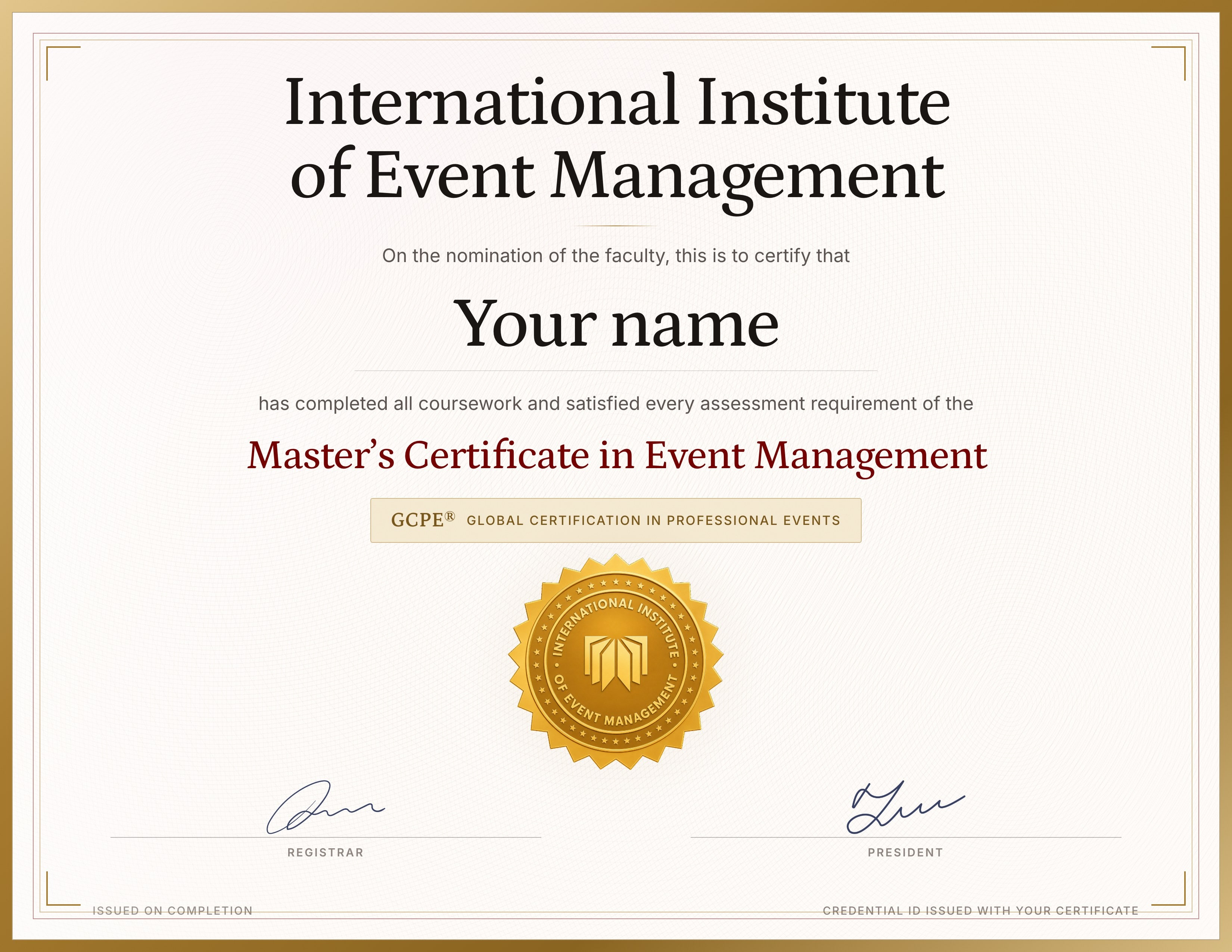
Master's Certificate in Event Management
Our complete six-module program combines corporate, social and wedding planning with the business of running an event practice. Build researched event proposals, work through crisis scenarios, develop a business plan for your market and set up a practice event online. Graded assignments include individual feedback. Completing the program awards the GCPE® credential.
- Self-paced
- 100% online
- ~6 months to complete
- Certificate + transcripts
- Awards GCPE®
$1,295paid in full
or 12 monthly payments of $119.
Free AI Starter Kit →
25 prompts, a client contract template and a pricing calculator.
“The Masters Certificate in Event Management happens to be the most highly technical academic work I have embarked upon in my entire academic pursuit. The course has equipped me with the required skill for a career change. With this, the sky is my starting point. Thank you once again.”
Chiedozie A.Master's Certificate, Nigeria
Who this is for
- You want the complete qualification, not one specialty
- You want the GCPE® credential, our highest award
- You are building a practice that handles both corporate and social work
- You want a US credential you can earn from your own country
Learn by doing the work
Observe events, research real options and turn realistic briefs into planning documents. These are examples of the assignments you submit for individual written feedback.
The Wedding Proposal
Create a planning package for a supplied couple’s brief: research real venues and vendors, build the budget, audit hidden costs, and write a timeline from setup to load-out.
Module 5: Wedding Planning
Event Management Business Plan
Research your actual market and two competitors, price three service tiers, and prepare a business plan with a contract annex and local compliance checklist.
Module 6: The Event Planning Business
Create an Event Online
Set up a fictitious event on an event platform, configure RSVP or ticketing and privacy settings, and document your work with screenshots. No real invitations or payments.
Module 6: The Event Planning Business
Skills you’ll put into practice
- Deliver corporate, social and wedding events to a professional standard
- Build and defend complex budgets, cash flow included
- Assess risk, arrange insurance and meet permit and safety rules
- Run hybrid and virtual events on current event technology
- Use AI for discovery, proposals, timelines and budgets, and know its limits
- Structure, price and market your own event practice
The curriculum
6 modules, 41 lessons and 18 graded assignments, about 49 hours of coursework. Open any module to read every lesson in it.
Module 1: An Introduction to Event Management
7 lessons, about 6 hours, 3 graded assignments- What Event Management Actually IsThe full event lifecycle, and why it resembles directing live theater.
- The Industry You’re Stepping IntoWhere the work lives, the career paths, and current BLS data.
- Do You Have What It Takes?The core traits, the modern additions, and a twenty-question self-assessment.
- Corporate, Social, and Virtual: Choosing Your LaneHow the three differ in money, hours and client type.
- The Events You’ll Work OnThe major event categories and what each one demands.
- Breaking In: Portfolio, Applications, and the InterviewRealistic entry points, building a portfolio from day one, ATS-readable résumés, structured interview prep.
- Your First 90 DaysHow to be useful before you are competent, and what new coordinators get wrong.
Graded assignments in this module
Personal fit statement (20 points)
Choose your event specialty, support your strengths with evidence, and write a 90-day development plan.
Interview preparation brief (40 points)
Research a real employer, prepare questions for the interviewer, and plan a mock interview with feedback.
Real event observation (40 points)
Attend or closely observe a real event, analyze its layout, staffing and flow, and turn your observations into a first portfolio case study.
You submit your work for individual written feedback against a four-criteria rubric. Pass mark 70%, one resubmission permitted.
Module 2: Fundamentals of Event Planning
7 lessons, about 9 hours, 3 graded assignments- Start with Why: Objectives and ROIFive kinds of objective, KPIs, and the ROI formula with worked examples.
- Timelines: The Plan Before the PlanMilestone-first planning, task ownership, and why a timeline does not end when the event starts.
- The Venue: Finding It, Walking It, Seating ItThe site inspection protocol, and seating layouts matched to purpose.
- Design: Making the Space Do the WorkDécor, key suppliers, lighting, and building ambiance on a real budget.
- Contracts: Protecting the Event and YourselfWhat a contract protects, and where the fee traps are.
- Invitations and Food & Beverage: The CommitmentsInvitation sequences, RSVP design, menu strategy, and alcohol and dram shop liability.
- Risk Management: The Thing That Separates Amateurs from ProsIdentification, assessment, mitigation, insurance, and contingency drills.
Graded assignments in this module
Event research report (30 points)
Analyze an event’s objectives, catering and timeline, then explain which planning decisions you would change.
The 100th anniversary gala, or the two-family wedding (50 points)
Work through a corporate or wedding brief: select venues, plan catering and transport, and prepare for delays and other risks.
Contract and risk exercise (20 points)
Complete an event brief and a register of at least 15 risks, with named owners and executable contingencies. Explain the contract clauses you would negotiate.
You submit your work for individual written feedback against a four-criteria rubric. Pass mark 70%, one resubmission permitted.
Module 3: Corporate Events
6 lessons, about 8 hours, 3 graded assignments- What Makes Corporate Events DifferentThe landscape in 2026, the five types, and defending the spend.
- Fundraisers and GalasThe cause, donor segmentation, the ask ladder, and modern fundraising tech.
- ConferencesCommittee structure, venue, speakers, food, AV, logistics and evaluation.
- Trade Shows and ExhibitionsBooth logistics, attracting visitors, promotional products, and lead qualification under privacy law.
- MeetingsPlanning, participants, timing, layout, and remote and hybrid in 2026.
- Team Building EventsSuccess factors, diagnosis-first design, and remote and hybrid formats.
Graded assignments in this module
Plan a networking event (40 points)
Build a plan with a venue, budget, sponsorship packages, promotional timeline, staffing and measures of success.
Design a team-building event (30 points)
Design activities for a 40-person team across three departments, including six remote colleagues, with logistics and a follow-up plan.
Observe a live corporate event (30 points)
Volunteer at or attend a corporate event, assess how its logistics serve its purpose, and recommend three specific improvements.
You submit your work for individual written feedback against a four-criteria rubric. Pass mark 70%, one resubmission permitted.
Module 4: Social Events
6 lessons, about 8 hours, 3 graded assignments- What Makes Social Events DifferentThe emotional stakes, who the client really is, and how success gets measured without an ROI formula.
- Birthdays and Milestone CelebrationsChildren’s parties, sweet sixteens, quinceañeras, milestone adult birthdays, and why surprise parties go wrong.
- Anniversaries5th through 50th, vow renewals, and adult children as the organizing client.
- Family ReunionsMulti-day structure, catering at scale, budgets split across households, four generations in one room.
- Showers and Small CelebrationsBaby and bridal showers, registries, gender reveals and their real risks, graduations, retirements.
- Managing Families, Not Just EventsDivorced parents, who pays and what they think it buys, saying no to the mother of the bride, and how to exit an engagement with grace.
Graded assignments in this module
Social event report (30 points)
Analyze a social event’s decision-makers, guest experience and planning choices, tracing problems back to their causes.
Hollywood-themed sweet sixteen (40 points)
Plan a 20-guest party within $3,000 using real restaurant and bakery research, accounting for family dynamics, dietary needs and accessibility.
Baby shower, start to finish (30 points)
Plan a 35-guest evening shower from consultation to cleanup, including a budget, timeline and a difficult guest-list conversation.
You submit your work for individual written feedback against a four-criteria rubric. Pass mark 70%, one resubmission permitted.
Module 5: Wedding Planning
6 lessons, about 9 hours, 3 graded assignments- Wedding Planning FundamentalsThe coordinator’s real job, service levels, compensation models, and the six-phase lifecycle.
- Venue, Budget and Financial ManagementVenue typology, site visits, budget architecture, who pays and what that means, the hidden-cost audit, negotiation, wedding insurance.
- Design, Décor and the Wedding AestheticThe design brief, style directions, florals, cake, attire and photography.
- Vendors and ProductionCatering and service styles, the bar, photography timelines, music, transportation, favors.
- The Wedding Day and BeyondThe twelve-month timeline, guest list and invitations, the wedding website, run-of-show, day-of coordination, post-wedding wrap.
- Modern WeddingsThemed, cultural and multicultural, LGBTQ+, micro-weddings and elopements, destination, hybrid and livestream.
Graded assignments in this module
The Wedding Proposal (60 points)
Create a planning package for a supplied couple’s brief: research real venues and vendors, build the budget, audit hidden costs, and write a timeline from setup to load-out.
Crisis Management Scenario (20 points)
Work through a wedding-day scenario involving rain, a photographer’s cancellation and a family conflict. Set decision deadlines, cost your alternatives and write what you would say.
Reflection (20 points)
Defend your approach to a planner’s role, cultural traditions or the limits of AI, using specific decisions and examples from the module.
You submit your work for individual written feedback against a four-criteria rubric. Pass mark 70%, one resubmission permitted.
Module 6: The Event Planning Business
9 lessons, about 9 hours, 3 graded assignments- Is This the Business For You?What the work is like, and what the business rewards.
- Understanding the Industry and Choosing Your NicheThe major segments, niches that work, and 2026 market realities.
- Legal Structure and Business SetupEntities, the registration checklist, insurance and workspace.
- Startup Costs, Pricing, and Unit EconomicsCash to open the doors against the first-year cost base, pricing models, and the math to check before you quote.
- Differentiating Your BusinessThe three levers, the underrated advantages, and what not to differentiate on.
- Marketing and Client AcquisitionThe five channels that work, the five that mostly do not, and the content engine.
- Contracts: The Planner Agreement and the Vendor AgreementNine clauses, clause by clause, plus the five most commonly missed.
- Operations, Technology, and the Year-One Scale ProblemThe core stack, the AI-augmented planner, cash flow and seasonality.
- Growing the Business: Hiring, Specializing, and Thinking About ExitThe solo plateau, the first hire, raising prices, and exit options.
Graded assignments in this module
Event Management Business Plan (40 points)
Research your actual market and two competitors, price three service tiers, and prepare a business plan with a contract annex and local compliance checklist.
The Green Meeting Proposal (40 points)
Write a client-facing proposal for a 200-person meeting, verifying venue practices and specifying waste measures, vendor commitments and how results will be measured.
Create an Event Online (20 points)
Set up a fictitious event on an event platform, configure RSVP or ticketing and privacy settings, and document your work with screenshots. No real invitations or payments.
You submit your work for individual written feedback against a four-criteria rubric. Pass mark 70%, one resubmission permitted.
An AI task in all 41 lessons
- Modules 1 and 2
Prompting
Using AI as a drafting assistant. Give it context, get a first draft, edit it into something you would send to a client.
- Modules 3, 4 and 5
Workflows
Chaining tasks and working from real documents, a brief, a contract, a guest list. The output is a finished file.
- Module 6
Systems
Building your own assistant, loaded with your templates, your pricing and your voice, then running your practice with it.
What you get
The GCPE® credential
Completing this program awards GCPE®, the Global Certification in Professional Events. You may use the mark on your résumé, business cards, website and marketing. There is no separate exam and no separate fee.
How you study
- All six modules and their materials, yours to keep
- Practical lesson exercises and graded assignments with individual feedback
- Lifetime access to curriculum updates
What you work from
- The AI prompt library, eleven planning workflows
What you end up with
- The GCPE® credential
- A digital certificate and official transcripts
- A digital badge for LinkedIn
Pricing
Monthly payment plan
$119/mo
12 payments of $119. You get full access from the first payment.
Enroll on the planNo application fee, no exam fee, nothing extra to buy. You have up to two years from enrollment at no additional cost. Read the refund policy.
Questions about this program
All FAQsWhat is GCPE® and is it accredited?
GCPE® is the Global Certification in Professional Events, a professional certification awarded by IIEM to graduates of this program. It is not an academic degree and it is not a license. It certifies that you have completed a structured, assessed program in professional event management.
How long does the Master’s Certificate take?
Most students finish in under six months studying part time. You have up to two years from enrollment at no extra cost.
Is there a separate exam or fee for GCPE®?
No. Completing the Master’s Certificate awards the credential. There is no separate exam and no separate fee.
What is the difference between the Certificate and the Master’s Certificate?
The Certificate programs cover one specialty (event management or wedding planning). The Master’s Certificate covers corporate, social and wedding events plus advanced planning, event technology and the business of running a practice, and it awards the GCPE® credential.
Do I need experience to enroll?
No. The requirements are English reading and writing, and an internet connection.
Can I pay monthly?
Yes. You can pay $1,295 in full, or 12 monthly payments of $119, which comes to $1,428 in total.
Is the credential recognized internationally?
The credential is issued from California, USA, and our graduates use it in 70 countries. It is a completed-education credential rather than a license. Credentials such as the CMP require several years of documented industry experience and a proctored exam; many of our graduates use GCPE® to enter the field and pursue CMP later.
Is the certificate digital or printed?
Your certificate and official transcripts are issued digitally the day you finish, plus a digital badge for LinkedIn. A printed copy can be ordered and posted to you for an additional fee.